As the year draws to a close, businesses are preparing budgets, reviewing financial performance and setting priorities for the year ahead. Marketing departments should be doing the same.
But an important question often gets overlooked in the year-end review: How well did your brand actually compete in the market?
Before we proceed, here is our tailored 2026 Brand and Competitor Analysis Scorecard
How visible was your company compared with its competitors? Which campaigns attracted the right audiences? Did your marketing communications influence customer decisions, strengthen brand perception or generate commercial opportunities? Which competitors captured attention that might otherwise have gone to your business? And where should your company invest its marketing resources in 2027?
These questions require more than a review of social media impressions, website traffic and advertising expenditure. They require a structured assessment of brand performance, competitive activity, audience behaviour, media effectiveness and the market conditions shaping customer decisions.
For businesses operating in increasingly competitive markets, the year-end marketing review should be treated as a strategic intelligence exercise, one that connects what happened during the year with what the business needs to do next.
This is where brand and market intelligence becomes valuable.

1. Move beyond reporting what happened to understanding why
Most marketing teams can produce an annual report showing how many campaigns they ran, how many people they reached, how much engagement their content generated and how much they spent.
These are useful measurements, but they do not automatically explain whether the business strengthened its competitive position.
Consider a company whose social media following increased by 35% during the year. At first glance, this appears to be a successful outcome. However, if its closest competitors grew by 60%, the company may be losing relative ground. If the new followers rarely engage with its content or fall outside its target market, the commercial value of that growth may be limited.
Similarly, a campaign may generate thousands of interactions without producing qualified leads, improving brand consideration or contributing to sales.
The reverse can also be true. A targeted campaign that attracts a smaller audience may generate stronger commercial results than a broad campaign that produces impressive reach but little meaningful action.
The distinction is between marketing activity, marketing effectiveness and competitive performance.
Marketing activity tells you what your team did. Marketing effectiveness tells you whether those activities achieved their intended objectives. Competitive performance tells you how your brand is positioned relative to the alternatives available to customers.
A credible year-end review must examine all three.
It should answer five fundamental questions:
- Visibility: How often and where did our brand appear in front of relevant audiences?
- Perception: What did customers, prospects and the wider market think about us?
- Competitiveness: How did our performance compare with direct competitors and emerging alternatives?
- Effectiveness: Which campaigns, messages and channels produced meaningful results?
- Commercial contribution: How did marketing support inquiries, opportunities, conversions, retention and revenue?
The answers form the foundation for a more informed marketing strategy.
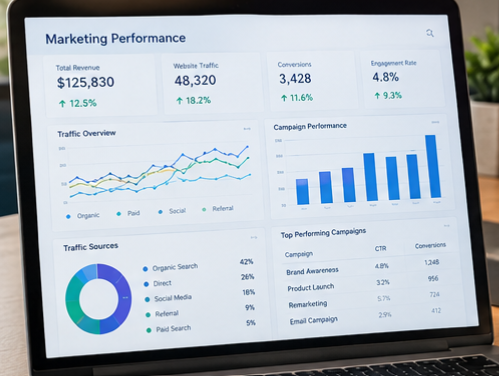
2. Establish a clear picture of your brand’s performance
Before comparing your business with competitors, establish a reliable baseline for your own performance.
This means reviewing the full range of brand communications delivered throughout the year, including digital campaigns, traditional advertising, public relations, events, sponsorships, partnerships, content marketing and customer engagement initiatives.
The review should be organised around the following dimensions.
A. Brand visibility and awareness
Visibility measures how frequently and where your brand appears. Awareness goes further by examining whether the intended audience recognises or recalls your brand.
For digital platforms, review:
- Reach and impressions across social media, paid campaigns and other digital channels.
- Growth in relevant followers and audience composition.
- Branded search activity and organic website traffic.
- Website visits from campaigns, referral sources and direct traffic.
- Video views, watch time and completion rates.
- Brand mentions across social media, online publications, blogs and other relevant sources.
For traditional media, examine:
- Newspaper and magazine coverage.
- Television and radio mentions, advertisements and interviews.
- Outdoor advertising placements and estimated exposure.
- Event visibility, sponsorship exposure and speaking opportunities.
- Coverage in trade publications and industry-specific media.
However, these figures should not be treated as interchangeable. An impression is not necessarily a person who noticed your advertisement. Potential media reach does not prove that a particular audience saw or remembered your coverage.
Where brand awareness is strategically important, supplement channel analytics with surveys, customer interviews or brand-tracking studies. Ask whether respondents recognise your brand, recall it without prompting, understand what it offers and would consider it when making a purchase.
The strategic question: Are we becoming more recognisable among the audiences that matter, or simply generating more activity?
B. Engagement and audience relevance
Engagement helps establish whether audiences are interacting with your content, but the quality of those interactions matters as much as their volume.
Review comments, shares, saves, clicks, direct messages, video retention, email interactions and meaningful website actions.
Go beyond the aggregate numbers. Examine which audience segments respond most strongly, which topics attract relevant conversations, and which formats encourage people to take the next step.
A professional services firm, for example, may find that its entertaining short-form videos attract broad attention while its technical tax explainers generate fewer interactions but more inquiries from decision-makers. Neither format should be judged by engagement alone because each may serve a different purpose.
Engagement rates also need consistent definitions. Some platforms calculate engagement against reach, others against followers or impressions. Comparing percentages without aligning their denominators can produce misleading conclusions.
The strategic question: Is our content attracting attention from the right people and moving them towards a meaningful action?
C. Brand perception and reputation
A brand is shaped by what a company communicates and by what the market says about it.
Review customer feedback, online reviews, testimonials, media coverage, social conversations, recurring complaints and the language people use when describing your business.
Look for patterns in:
- Trust, credibility and perceived expertise.
- Product or service quality.
- Price and value perceptions.
- Customer experience and responsiveness.
- Differentiation from competitors.
- Common objections and reasons customers choose alternatives.
Where data permits, analyse sentiment over time and identify what drives positive, negative or neutral conversations. Automated sentiment tools can help organise large volumes of feedback, but they should be checked against the underlying context, particularly for sarcasm, local language and industry-specific terminology.
For brands in Kenya and the wider East African market, local context is particularly important. A message that resonates with one audience may not translate equally across countries, sectors, languages or customer segments.
The strategic question: Does the market perceive us in the way we intend to be perceived?
D. Website and conversion performance
A company’s website is often one of its most important marketing assets, particularly for businesses selling professional services, technology, financial services or other considered purchases.
Assess traffic sources, landing-page performance, search visibility, user journeys, enquiry forms, downloads, calls, bookings and conversion rates.
Review whether campaigns attracted visitors who explored relevant services and completed meaningful actions. Identify pages with high traffic but weak conversion, as well as pages that attract relatively little traffic but generate qualified inquiries.
Where possible, connect marketing analytics with CRM records and sales outcomes. This helps distinguish general interest from genuine commercial opportunity.
For longer sales cycles, such as consulting engagements or business-to-business services, do not judge campaigns solely on immediate conversions. A campaign may introduce the brand to a prospect months before a formal enquiry or purchase.
The strategic question: Is our digital presence helping prospective customers move from awareness to consideration and action?
E. Marketing expenditure and return
Every marketing activity consumes resources, whether through advertising expenditure, production costs, agency fees, sponsorships, staff time or technology subscriptions.
Review expenditure against the original campaign objectives and the outcomes achieved.
Depending on the campaign, relevant measures may include cost per lead, cost per qualified lead, cost per acquisition, conversion rate, customer lifetime value, incremental revenue and return on marketing investment.
Where revenue can be credibly attributed to marketing, a basic calculation is:
Marketing ROI = (Incremental profit attributable to marketing − marketing investment) ÷ marketing investment × 100%
Use incremental profit rather than simply equating all campaign-attributed revenue with profit. Also recognise that attribution models, customer journeys and external factors can complicate the calculation.
Not every marketing investment will generate an immediate sale. Brand-building, public relations, thought leadership and sponsorship may contribute through awareness, trust, preference or future demand. Their contribution should be measured against suitable objectives rather than forced into a short-term sales model.
The objective is not to eliminate every activity that cannot be tied to immediate revenue. It is to understand what the investment achieved, what evidence supports that conclusion and whether the activity deserves continued investment.
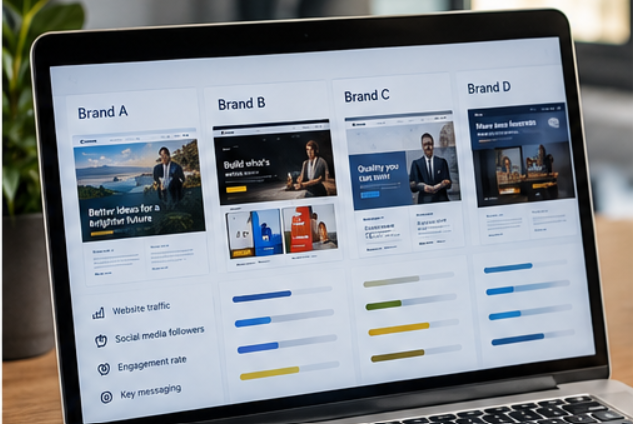
3. Benchmark your brand against competitors
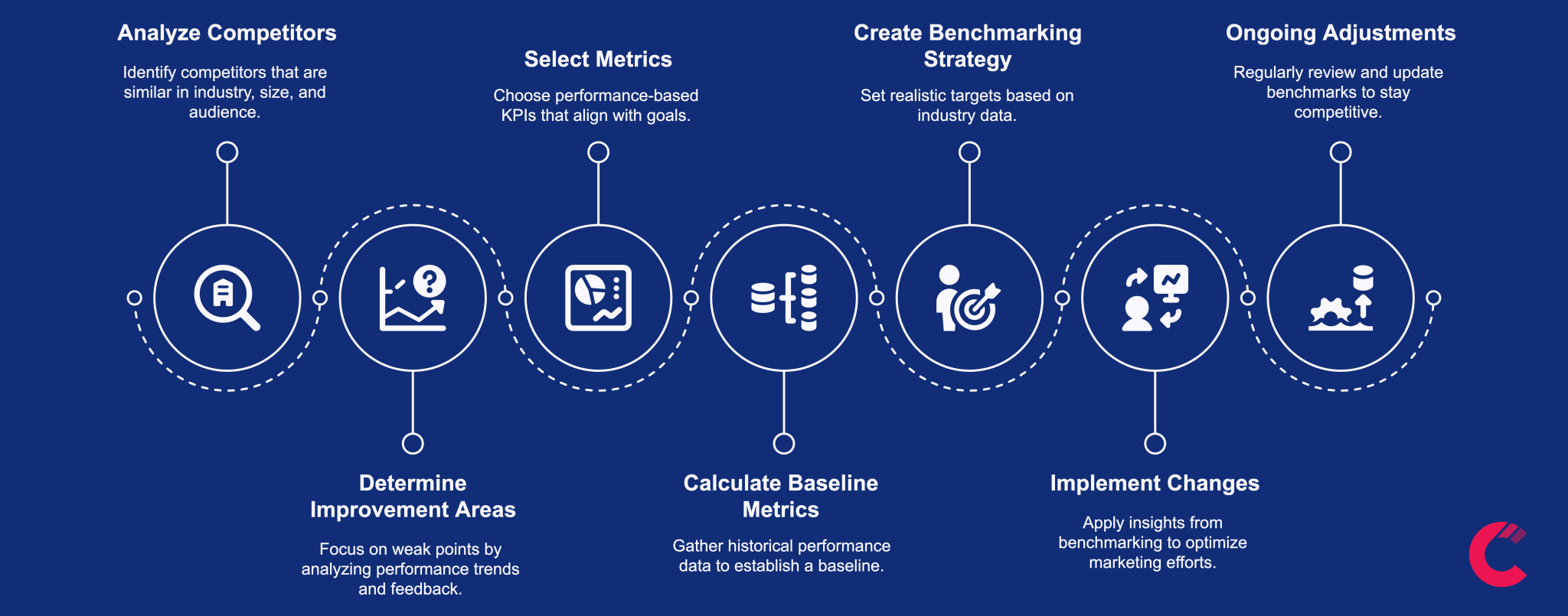
Internal performance tells you whether your marketing is improving. Competitor benchmarking helps establish whether that improvement is strengthening your position in the market.
Start by identifying a defined competitive set. This should include direct competitors, businesses targeting the same customers, credible substitutes and emerging players that may be changing customer expectations.
Avoid comparing your brand with every organisation in your industry. A competitor set that is too broad creates noise, while one that is too narrow can hide important threats.
For most businesses, five to eight relevant competitors can provide a useful starting point, adjusted for the size and complexity of the market.
What should you compare?
1. Digital presence and content performance
Examine competitors’ active platforms, publishing frequency, audience growth where observable, content themes, video performance, engagement patterns and calls to action.
Identify what they publish consistently, which topics attract attention, what audiences ask in the comments and which content formats appear to support their positioning.
Public data has limitations. You generally cannot see competitors’ private analytics, actual conversions or complete advertising results. Treat publicly visible engagement as a signal, not proof of business performance.
2. Brand positioning and messaging
Review how competitors describe themselves, the problems they claim to solve, the audiences they target and the benefits they emphasise.
Compare their value propositions, brand promises, visual identities, tone of voice, proof points and differentiators.
Ask whether competitors are competing on price, convenience, expertise, innovation, customer service, scale or trust. Look for areas where several brands sound almost identical, as well as customer needs that appear under-addressed.
3. Paid advertising and campaign strategy
Investigate publicly available advertisements, campaign messages, creative formats, landing pages, offers and calls to action.
For eligible digital channels, advertising transparency libraries can reveal active or archived creative and, depending on the platform and ad category, additional information about advertisers or delivery.
These resources help you understand campaign themes and messaging. They do not necessarily reveal complete spending, targeting, conversion or return-on-investment data.
4. Traditional media and public relations
Track competitor appearances in relevant newspapers, radio, television, trade publications, industry events and business forums.
Record the themes they are associated with, the spokespeople quoted, the publications covering them and the frequency and context of their appearances.
This can reveal which competitors are building authority in particular subjects, cultivating media relationships or positioning themselves as voices in important industry conversations.
5. Search visibility and discoverability
Review which competitors appear for important industry keywords, customer questions and commercial searches.
Compare their search visibility, service pages, educational resources, backlinks and local search presence where relevant.
Do not limit the exercise to rankings for your company name. Examine the questions prospects ask before they know which provider to choose.
6. Customer experience and reputation
Review publicly available ratings, testimonials, complaints, response times where observable, customer service themes and recurring feedback.
This can reveal opportunities for differentiation, such as clearer communication, better onboarding, faster responses or more useful educational content.
Build a competitive scorecard
A structured scorecard makes the findings easier to interpret and communicate to management.
| Dimension | What to assess | Strategic value |
|---|---|---|
| Visibility | Media coverage, search presence, social reach indicators | Identifies visibility gaps |
| Positioning | Value proposition, messaging, differentiation | Reveals opportunities to stand apart |
| Content | Themes, formats, consistency, audience response | Informs content planning |
| Paid media | Creative, offers, landing pages, campaign themes | Informs campaign development |
| Reputation | Reviews, sentiment, recurring customer concerns | Highlights trust and experience opportunities |
| Website | Search visibility, service pages, conversion pathways | Identifies digital improvements |
| Market relevance | New services, partnerships, emerging customer needs | Reveals potential threats and opportunities |
Score each dimension using a consistent scale, such as 1 to 5, and document the evidence supporting every rating. Treat the score as a structured assessment, not an objective measurement of a competitor’s entire business.
Where a category lacks reliable evidence, mark it as unknown rather than assigning an arbitrary score.
The most useful output is not a ranking of who has the best-looking social media page. It is a clear understanding of where your brand leads, where competitors are stronger, why those differences may exist and what your company should do about them.
4. Measure your share of voice
Share of voice (SOV) helps establish how much of the relevant conversation your brand captures compared with competitors.
A simple mention-based calculation is:
Share of voice = Your brand’s relevant mentions ÷ Total relevant mentions across the defined competitive set × 100%
Suppose a company and four competitors generate 2,000 relevant media mentions over a defined period, of which the company receives 400.
Its mention-based share of voice is 20%.
This is useful only when the sources, keywords, time period and counting rules are consistent. A mention-based share of voice is not the same as share of advertising expenditure, audience reach, market share or revenue.
Where possible, calculate share of voice separately for social media, online news, traditional media and other relevant channels before creating an overall view. Different channels serve different purposes and have different measurement limitations.
Then compare the results with the previous period, competitor activity and changes in business performance.
Ask:
- Is our share of relevant conversation growing or declining?
- Which competitors dominate particular subjects or customer segments?
- Are our media mentions associated with our intended positioning?
- Do spikes in conversation coincide with campaigns, events or external news?
- Are we visible in the places where our target customers seek information?
Share of voice becomes more valuable when connected to business objectives. If a company wants to be recognised for expertise in cybersecurity, for example, it should examine its presence in cybersecurity-related conversations rather than counting every mention of its name.

5. Evaluate digital and traditional media as one marketing ecosystem
Digital and traditional media should not be assessed as competing alternatives in isolation. Each can play a different role in building awareness, credibility, consideration and demand.
Digital channels often offer more granular and immediate performance data. Traditional media can provide access to specific audiences, established editorial environments and forms of visibility that may be difficult to replicate digitally.
The appropriate mix depends on the audience, business model, geography, campaign objective, budget and evidence of effectiveness.
| Channel | What to measure | Where it can be particularly useful | Main limitation |
| Social media | Reach, engagement, clicks, video retention, enquiries | Awareness, community, education and engagement | Platform metrics do not automatically demonstrate commercial impact |
| Paid search | Search impressions, clicks, conversion rate, cost per lead | Capturing existing demand | Performance depends on search intent, competition and landing-page quality |
| Organic search | Rankings, organic traffic, qualified enquiries | Long-term discoverability and education | Results can take time and fluctuate |
| Online display and video advertising | Impressions, viewability, completed views, conversions | Broad reach and repeated exposure | Exposure does not necessarily mean attention or recall |
| Email marketing | Deliverability, clicks, unsubscribes, downstream conversions | Nurturing existing contacts and prospects | Results depend on list quality, relevance and consent |
| Public relations | Relevant coverage, message inclusion, share of voice, referral traffic | Credibility, authority and reputation | Coverage volume alone does not establish impact |
| Television and radio | Verified placements, audience estimates, frequency, enquiries | Broad or geographically targeted awareness | Audience estimates and exposure do not prove attention or recall |
| Print media | Placements, circulation evidence, target-audience relevance, response | Specialist audiences and considered purchases | Circulation is not the same as readership |
| Outdoor advertising | Location quality, estimated exposure, campaign recall, response | Local awareness and repeated visibility | Attribution can be difficult without supporting measurement |
| Events and sponsorships | Target-audience attendance, qualified conversations, follow-ups, opportunities | Relationship-building and business development | Attendance and logo exposure are weak proxies for commercial impact |
For traditional media, use credible circulation data, broadcaster audience research, placement records, independent monitoring and campaign-specific response mechanisms wherever available. Avoid relying solely on advertising value equivalency as proof of PR effectiveness.
For digital campaigns, review platform analytics alongside website analytics and CRM outcomes. This reduces the risk of optimising for inexpensive clicks or superficial engagement at the expense of meaningful business results.
The central question is not whether digital or traditional media is inherently superior. It is which combination reaches the intended audience, communicates the right message and contributes most effectively to the desired outcome.
6. Use the right tools for the right intelligence question
The market offers a range of platforms for marketing analytics, competitor benchmarking, media monitoring and social listening. No single tool is automatically the best choice for every organisation.
Some tools measure activity on channels you own. Others analyse publicly available competitor information. More specialised platforms monitor news coverage, social conversations, sentiment and reputation across a much wider media landscape.
The right combination depends on the questions your business needs to answer, the channels it uses, the level of analytical depth required and the budget available.
A. Core measurement and reporting tools
Google Analytics 4 (GA4)
Useful for understanding website acquisition, visitor behaviour, engagement, key events and conversion pathways. It can help establish whether marketing campaigns are bringing relevant traffic to your website and what visitors do after arriving.
Its main limitation is that it does not independently provide a complete picture of competitor performance, offline exposure or every interaction in a complex customer journey.
Google Search Console
Useful for evaluating organic search visibility, search queries, clicks, impressions, click-through rates and indexing issues for your own website.
It helps identify what audiences are searching for when they discover your business. It is not a comprehensive competitor intelligence platform.
Native social media analytics
Tools available within platforms such as LinkedIn, Meta, YouTube and TikTok provide performance information for eligible accounts and content.
These are often the most practical starting point for reviewing owned-channel performance. However, the available metrics vary by platform, and competitor analytics are generally less complete than those for accounts you manage.
Looker Studio and Power BI
These tools help consolidate data into dashboards and reports. Looker Studio can be useful for combining supported marketing data sources in accessible visual reports, while Power BI can support broader integration and analysis across business datasets.
Neither platform automatically supplies missing data. The quality of the dashboard depends on the reliability, consistency and completeness of the underlying sources.
B. Competitive intelligence and media monitoring platforms
For businesses that need to monitor competitors, track brand reputation and understand how their brands appear across the market, specialist intelligence platforms can provide capabilities beyond standard website and social media analytics.
Three platforms worth evaluating are Meltwater, Talkwalker and Brandwatch. Although their capabilities overlap, each offers tools for analysing media coverage, public conversations, audience insights and competitive activity. Features, data access and pricing vary by subscription, so businesses should assess each platform against their specific needs.
Meltwater: Media intelligence and reputation monitoring
Meltwater is particularly relevant to businesses seeking to monitor media coverage, brand mentions, public conversations, competitor activity and reputation across digital and traditional sources. Its offerings include media monitoring and consumer insights capabilities.
Best suited to: organisations that need a broader view of public relations, brand reputation and media presence.
Consideration: it is a specialist intelligence platform, so the organisation should evaluate whether its scope and commercial cost are justified by the frequency and importance of its monitoring needs.
Talkwalker: Social listening and consumer intelligence
Talkwalker offers social listening, social benchmarking, media monitoring and audience insights. Its media monitoring offering covers online news and social media alongside traditional media sources, with features such as sentiment analysis and alerts.
Best suited to: organisations that require detailed analysis of conversations, competitor visibility, reputation and emerging audience trends.
Consideration: confirm that the platforms, languages, local media sources and historical data available meet your specific market requirements.
Brandwatch: Social intelligence and audience research
Brandwatch is worth evaluating for social listening, audience research and competitor analysis, particularly where the objective is to understand what people discuss, how perceptions change and which themes shape public conversations. Its competitive analysis guidance also highlights benchmarking and configurable analytical dashboards.
Best suited to: marketing and research teams that need deeper social and consumer intelligence.
Consideration: social conversation data is only one part of market performance. It should be combined with web analytics, commercial data and traditional media monitoring where relevant.
C. How should you choose between them?
| Requirement | Practical starting point | When to consider a specialist platform |
| Measure website performance | GA4 and Search Console | When broader market intelligence is also required |
| Evaluate owned social channels | Native platform analytics | When cross-platform reporting or competitor benchmarking is needed |
| Consolidate marketing reports | Looker Studio or Power BI | When the team needs integrated media, audience and market intelligence |
| Track traditional and online media coverage | Manual monitoring or a suitable local monitoring provider | When coverage volume, speed or breadth makes manual tracking insufficient |
| Analyse audience sentiment and competitor conversations | Structured research and available social analytics | When continuous, multi-source social listening is important |
| Track competitors’ positioning and campaigns | A defined competitor audit using public sources | When frequent monitoring across many competitors justifies automation |
For organisations operating in Kenya and East Africa, local data coverage deserves particular attention. A platform with extensive international coverage may still miss relevant local radio, print, industry publications, regional language conversations or smaller digital outlets.
Before purchasing, ask vendors to demonstrate performance using a sample of your actual competitors, relevant keywords and priority media sources. Test the quality of the results rather than relying on a feature list alone.
Also distinguish software costs from the cost of producing useful intelligence. A sophisticated platform will not compensate for unclear research questions, poor measurement definitions or reports that do not lead to decisions.
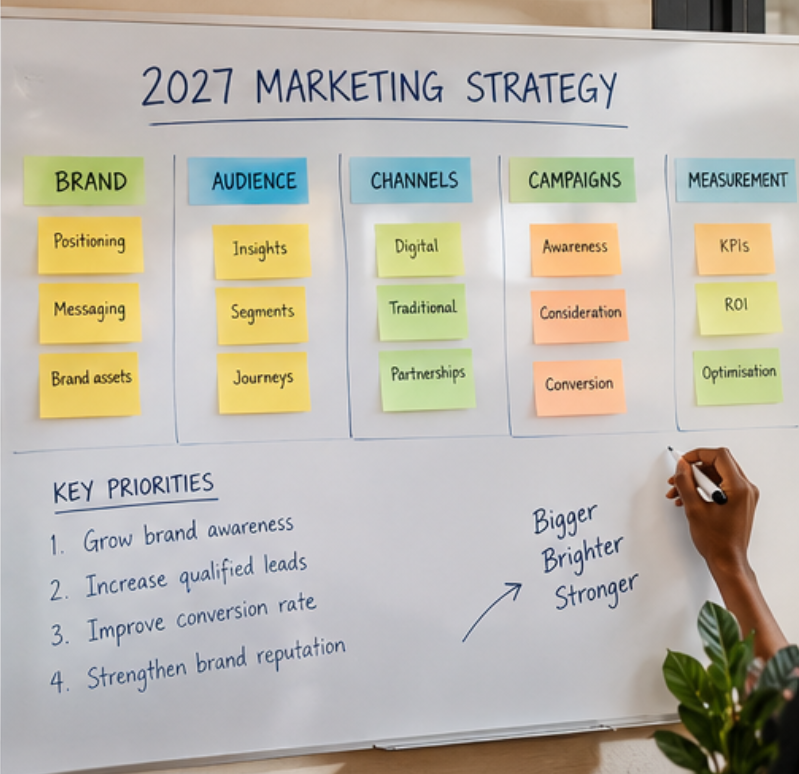
7. Turn the findings into a stronger marketing strategy for 2027
The purpose of the year-end review is not to produce a report that is filed away in January. It is to change how the organisation competes.
Once internal performance and competitor activity have been analysed, translate the findings into a set of deliberate strategic decisions.
Step 1: Identify the most important performance gaps
Compare your results with the original objectives, previous periods, relevant competitors and available market benchmarks.
Separate weaknesses caused by execution from those caused by strategy.
For example, low website conversions could reflect weak landing pages, poor targeting, an unclear value proposition or a mismatch between the campaign promise and the service being offered. Each requires a different response.
Prioritise gaps based on their business impact, the strength of the evidence and the feasibility of addressing them.
Step 2: Refine your positioning
If competitor analysis shows that several businesses use almost identical messaging, your opportunity may be to clarify what makes your organisation distinct.
That distinction must be credible. It could be specialist expertise, speed of delivery, a particular customer experience, local knowledge, a differentiated service model or demonstrable results.
Translate the positioning into consistent messaging across the website, sales materials, advertising, public relations, social media and customer communications.
The objective is not simply to sound different. It is to make the value of choosing your business easier to understand.
Step 3: Reallocate your marketing budget
Use the evidence to determine which activities deserve more investment, which need improvement and which should be reduced or stopped.
A practical classification is:
- Scale: Activities with convincing evidence of effectiveness and room for growth.
- Optimise: Activities with promising results but identifiable performance gaps.
- Test: New channels, messages or audiences where evidence is still limited.
- Reduce or stop: Activities that repeatedly fail to meet their objectives and have no credible strategic justification.
Do not base budget decisions solely on the lowest cost per click or the highest engagement rate. Consider audience quality, customer lifetime value, brand-building effects, strategic priorities and the limitations of attribution.
Where uncertainty remains, reserve a defined portion of the budget for controlled experiments rather than committing the entire allocation to familiar activities.
Step 4: Build an audience-led content strategy
Use campaign performance, customer feedback, search data, competitor messaging and sales-team insights to identify the subjects your audience cares about.
Develop content around actual questions, objections and decisions. For example, a professional services firm may prioritise practical explainers, industry commentary, case studies, expert interviews and regulatory updates instead of publishing generic corporate messages without a clear audience need.
Assign each content theme a purpose. Educational content may support discovery and trust, case studies may help establish credibility, and service-specific content may support consideration and inquiries.
Measure the content against its intended role rather than expecting every post to generate immediate leads.
Step 5: Improve channel selection and integration
Identify where your target audience spends time, which sources it trusts and which channels influence its decisions.
Use digital channels where targeting, interaction and measurement support the objective. Use traditional media, public relations, events and partnerships where they offer access, credibility or influence that digital activity alone may not deliver.
Plan campaigns as connected journeys. An interview in a business publication might be amplified through LinkedIn, supported by a website article and followed by a targeted email campaign. Track the contribution of each component without assuming that the last click tells the whole story.
Step 6: Set measurable objectives and accountability
Every significant campaign should have a clear objective, target audience, intended outcome, budget, measurement method and accountable owner.
Avoid vague objectives such as increasing visibility or improving engagement without defining what those outcomes mean.
For example, a business might aim to increase qualified inquiries from a particular customer segment, improve unaided brand awareness among decision-makers, increase relevant media coverage or reduce the cost of acquiring qualified leads.
Establish baselines before setting targets. Where no reliable baseline exists, conduct an initial measurement exercise and use the findings to establish realistic benchmarks.
Step 7: Make intelligence a continuous process
A year-end review provides a useful starting point, but competitor activity and audience expectations change throughout the year.
Introduce a recurring review cycle:
- Monthly: Monitor campaign performance, audience response, website conversions and significant competitor activity.
- Quarterly: Review share of voice, brand perception indicators, content performance, channel contribution and budget allocation.
- Annually: Reassess positioning, the competitive landscape, marketing effectiveness and the priorities for the next financial year.
Assign responsibility for collecting, validating and interpreting the data. Present the findings in a concise management dashboard that links each major insight to a decision, action, owner and deadline.
This is how marketing measurement becomes a management discipline rather than an annual reporting exercise.
8. Common mistakes that weaken year-end marketing reviews
Even organisations with substantial marketing budgets can draw the wrong conclusions if their measurement approach is incomplete.
Confusing activity with impact. Publishing more content or running more advertisements does not necessarily mean the brand became more competitive.
Comparing incompatible metrics. Different platforms calculate reach, engagement and views differently. Definitions must be aligned before comparisons are made.
Assuming competitor visibility equals competitor success. Public engagement and media coverage reveal useful signals but do not disclose complete commercial performance.
Ignoring traditional media. A review based only on digital analytics may overlook influential coverage, broadcast exposure, industry publications and event-based engagement.
Treating all audiences as equally valuable. Large audiences are not automatically better audiences. Relevance and the likelihood of achieving the business objective matter.
Over-relying on last-click attribution. A prospect may encounter a brand through an event, a media interview, a search result and several pieces of content before making contact. Last-click reporting can understate the contribution of earlier interactions.
Buying tools before defining the problem. Software should serve the intelligence requirement, not determine it. Begin with the decisions management needs to make, then identify the data and tools needed to support them.
Producing reports without action plans. An insight only creates value when it changes a decision, validates an existing direction or helps the organisation respond more effectively to the market.
9. A practical 30-day plan for your year-end review
Businesses do not need to overhaul their entire marketing function to begin. A structured 30-day exercise can establish a useful baseline and identify immediate priorities.
Week 1: Establish the baseline
Gather campaign reports, website analytics, social media data, advertising expenditure, media coverage, customer feedback, sales information and the original marketing objectives. Identify missing data and standardise the core metrics.
Week 2: Conduct the competitor review
Select the most relevant competitors. Audit their positioning, digital presence, content, campaigns, media coverage, reputation and search visibility. Document evidence, uncertainties and emerging patterns.
Week 3: Develop the intelligence findings
Compare internal performance with the competitive landscape. Identify the strongest-performing channels, significant weaknesses, audience needs, positioning gaps and opportunities for differentiation.
Week 4: Translate findings into the 2027 plan
Agree on marketing priorities, target audiences, campaign themes, channel allocation, budget adjustments, performance indicators and reporting responsibilities. Establish a measurement calendar so that progress can be reviewed throughout the year.
The final deliverable should be more than a collection of charts. It should be a decision-ready marketing intelligence report that explains what happened, why it matters, where the organisation stands and what it should do next.
10. How Sahihi Media can help your business compete more intelligently
At Sahihi Media, we believe effective marketing begins with understanding the market, the audience and the position a brand occupies within its competitive environment.
As a Brand and Market Intelligence company, we help businesses move beyond isolated marketing metrics to develop a clearer understanding of brand performance, competitor activity, audience behaviour and opportunities for growth.
Our work connects intelligence with practical marketing decisions, helping organisations understand not only how their communications performed, but also how they can improve their competitive position.
Depending on your objectives, our support can include:
Brand performance audits
We assess your brand’s positioning, messaging, visual consistency, digital presence and communication effectiveness to identify strengths, weaknesses and opportunities for improvement.
Competitor intelligence and benchmarking
We examine relevant competitors’ communications, campaigns, content strategies, public visibility and positioning to identify competitive gaps, emerging threats and opportunities for differentiation.
Digital marketing and campaign analysis
We evaluate available website, search, social media and campaign data to understand what is working, what needs improvement and where marketing resources could be deployed more effectively.
Media intelligence and reputation analysis
We help assess relevant media coverage, public brand mentions, communication themes and reputation signals to understand how your organisation appears in the wider market.
Marketing strategy and planning
We translate the findings into actionable recommendations covering positioning, messaging, content, channel selection, campaign priorities, budget considerations and performance measurement.
Creative, digital and communication execution
Where the analysis identifies an opportunity, we can support the next stage through brand development, content creation, digital marketing, website development, creative production and integrated communications.
Our approach is designed to connect the analytical and creative sides of marketing. The objective is not to produce more reports or more content for its own sake. It is to help your business make better-informed decisions about where to compete, how to communicate and how to create meaningful value for its audience.
Start 2027 with intelligence, not assumptions
Your competitors have spent the year communicating, advertising, building relationships and shaping customer perceptions. Your customers have been forming opinions, expressing preferences and making decisions. The market has been changing, whether or not your organisation has been monitoring those changes.
A year-end review is an opportunity to understand what those developments mean for your business.
Before approving next year’s marketing budget, ask whether you know which campaigns delivered value, which competitors are gaining ground, what your audience expects and where your brand has the greatest opportunity to stand out.
If those answers are unclear, more marketing activity may not solve the problem. Better intelligence may be the more important first investment.
Sahihi Media helps you understand your brand, your market and your competition, then turn those insights into a more informed marketing strategy.
Visit sahihimedia.co.ke to explore how we can support your brand and market intelligence needs.
The brands that compete effectively in 2027 will not necessarily be those that communicate the most. They will be those that understand their market well enough to make every important marketing decision count.